
Corporate Aviation Staffing Trends in 2026: What Every Flight Department Needs to Know The...
How to Become a Corporate Flight Attendant: The Complete Career Guide for 2026
The corporate flight attendant career is one of the least understood and most underestimated in professional aviation. It combines the service orientation of luxury hospitality with the technical demands of aviation safety, and it operates in an environment where the standards are set not by a scheduling algorithm but by the specific preferences of some of the world's most demanding and discerning travelers.
For people who are attracted to professional aviation but who are not pursuing a pilot career, or who are transitioning from commercial flight attendant roles and want the lifestyle and service quality that private aviation offers, the corporate FA path represents a genuinely compelling career option.
This guide covers the realistic requirements for entering and advancing in the corporate flight attendant profession in 2026, from initial training to rate setting to building a contract career that provides both professional satisfaction and financial stability.
What Corporate Flight Attendants Actually Do
On a private jet, the flight attendant is the primary, and often the only, cabin crew member. There is no purser to escalate issues to, no second FA to split duties with, no company service manual that dictates exactly what will be served and when. The corporate FA is responsible for everything in the cabin from wheels-up to touchdown.
The safety dimension comes first: pre-flight safety checks of all cabin equipment, passenger briefings, securing the cabin for departure and arrival, and the ability to manage any in-flight medical emergency or safety event. The FAA requires certificated FAs to be trained and current on the specific aircraft they fly, which means aircraft-specific emergency procedure training is not optional.
The service dimension is equally demanding in a different way. Corporate FAs working with regular principals study their passengers' preferences with the same attention a personal assistant would. Preferred beverages, dietary restrictions, service style preferences, music, temperature, even the way they prefer communication during the flight are all things that experienced corporate FAs know and manage without prompting.
Contract corporate flight attendants in the CrewBlast network work across multiple operators and aircraft types, building a broad experiential base that makes them more valuable over time. Register as a crew member at crewblast.co/register.
Training Requirements for Corporate Flight Attendants
 The regulatory minimum for a certificated flight attendant is completion of an initial training program covering basic aviation safety and emergency procedures, followed by aircraft-specific emergency procedure training for each aircraft type the FA will operate on. The FAA issues a certificate of demonstrated proficiency to FAs who complete the training and pass a check conducted by an authorized check airman.
Several training providers offer comprehensive initial corporate flight attendant training that covers both the FAA-required safety content and the service skills specific to business aviation: galley management, menu planning, passenger service at altitude, and the professional standards expected in high-end private aviation. Providers include FACTS Training, NATA, and FlightSafety International.
Aircraft-specific training is a recurring cost in a corporate FA career. Each aircraft type requires its own emergency procedure training, and that training must be completed within the preceding 12 months to maintain currency. An FA who operates on four different aircraft types maintains four separate training records and budgets for four annual recurrent training completions.
First aid and CPR certification is a standard requirement for any professional corporate FA. At altitude, help from external emergency services is unavailable. The FA is the first and only medical responder for the duration of the flight, and the basic life support skills need to be current and practiced.
What Corporate Flight Attendants Earn
Corporate flight attendant compensation varies significantly between full-time employed and contract positions. Full-time corporate FAs in established flight departments earn between $65,000 and $120,000 annually depending on the aircraft type, the market, and the demands of the specific position.
Contract corporate FAs bill at daily rates that reflect both the aircraft type and their experience level. Current market rates tracked through the CrewBlast Daily Rate Survey show experienced contract FAs on large-cabin jets billing $900 to $1,200 per day.
The financial advantage of contract work over full-time employment emerges at consistent working volumes. A contract FA who averages 15 working days per month at $1000 per day gross earns $180,000 per year before expenses. Against a full-time salary of $160,000 plus benefits, the contract advantage is real at that volume, though it requires the discipline to manage the income variability that comes with contract work.
International experience and language skills command meaningful premiums. An FA with fluent Mandarin working Middle Eastern and Asian routes, or a Spanish-fluent FA serving Latin American clientele, can command rates 20 to 30 percent above the base rate for their aircraft type.
Building a Contract Career as a Corporate FA
 The contract corporate FA career is built on reputation, availability, and the professional quality of the service delivered on each trip. Unlike pilot careers where the primary credential is the type rating, corporate FA careers are more nuanced: the service skills, the specific passenger relationships, and the professional personality matter as much as the safety training.
New corporate FAs entering the market benefit from building their initial reputation with operators who are willing to give newer FAs trips on less demanding routes. Every trip completed professionally is a reference. Every operator who calls again after a first trip is a relationship worth cultivating.
Joining platforms that give you visibility to a broad range of operators dramatically accelerates the networking process that would otherwise take years of industry events and word-of-mouth referrals.
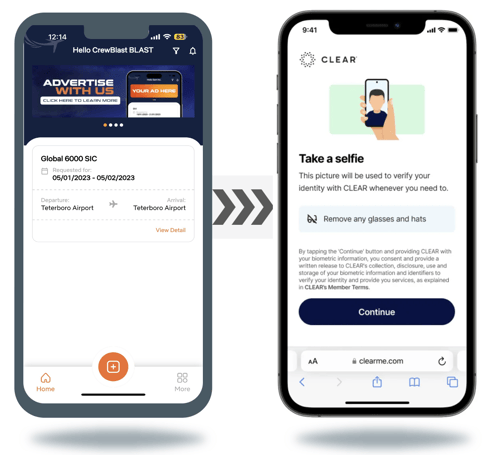
Registering as a flight attendant on CrewBlast gives you immediate access to operator requests across the country and, for international trips, globally. The platform's verification process, including CLEAR biometric verification, gives operators the confidence to book FAs they have not previously worked with.
The corporate flight attendant career in 2026 is a genuine professional path with strong compensation potential, meaningful work, and the kind of variety that few other careers can offer. The barriers to entry are real, involving specific training, certifications, and a professional standard that takes time to develop, but they are not prohibitive for motivated people.
The market for qualified corporate FAs is strong and, given the overall growth in business aviation activity and the continuing expansion of the private jet fleet, likely to remain so. The operators who need professional cabin crew will continue to need them, and the FAs who combine safety competence with genuine service excellence will continue to be in demand.
The career is worth building. The tools to build it are available. What remains is the commitment to the standards the profession demands.
|
Join the CrewBlast FA Network — Visit crewblast.co/register |