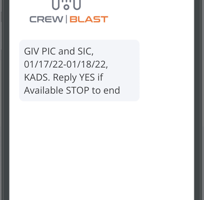
CrewBlast is in need of a GIV PIC and SIC for a trip commencing on January 17, 2022 thru January...
Every flight department depends on operational infrastructure.
Dispatch software coordinates trips. Flight planning software optimizes routes. Maintenance platforms monitor aircraft health. Safety Management Systems help identify risk before it becomes an incident. Every one of these technologies exists for the same reason: to reduce uncertainty before an aircraft ever leaves the ground.
Yet one of the most important operational functions in business aviation is still managed reactively.
Staffing.
When a pilot becomes unavailable, a flight attendant times out, an owner extends a trip, or a new aircraft enters the fleet, many operators still turn to recruiters, public Facebook groups, LinkedIn posts, email chains, or countless phone calls. Those methods may eventually produce a qualified crewmember, but they were never designed for an industry where time, discretion, and operational continuity are critical.
That isn't a staffing problem. It's an infrastructure problem.
The business aviation industry has spent decades modernizing almost every operational workflow, yet staffing remains one of the last functions dependent on manual effort and public marketplaces. The question shouldn't be, "How do we find a pilot?" It should be, "Why are we still searching in the first place?"
That is the question that led to the development of CrewBlast OS.
Beyond the Marketplace
Most staffing platforms are marketplaces. Their purpose is to connect employers with candidates. While that model has worked for many industries, it was never designed for the unique demands of business aviation.
A flight department doesn't simply need resumes. It needs confidence that the right crewmember can be identified, qualified, onboarded, and assigned quickly without exposing operational information or creating hours of administrative work.
CrewBlast OS was designed as operational infrastructure rather than a marketplace.
Instead of encouraging operators to post publicly and wait for responses, CrewBlast OS provides a dedicated operator platform connected to CrewBlast's global network of pilots and flight attendants. Operators can upload and prioritize their preferred contractors while maintaining immediate access to a broader network whenever additional support is required. Whether filling a last-minute contract trip or recruiting for a full-time position, every staffing workflow is managed from the same secure environment.
The goal isn't simply to find crew faster. The goal is to eliminate everything that slows staffing down.
Finding Crew Isn't the Hard Part
 Finding available crews has never been the biggest operational challenge.
Reviewing them has.
Anyone can generate resumes. The real work begins after the responses arrive. Flight departments must review certificates, medicals, type ratings, recurrent training, resumes, and other documentation before making a staffing decision. Every minute spent reviewing paperwork is time taken away from managing the operation itself.
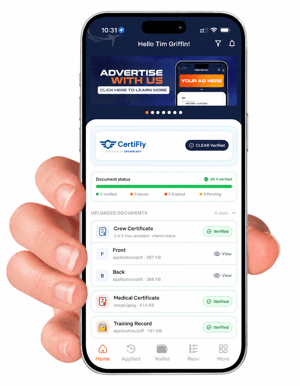
That is why CrewBlast OS includes CertiFly™, CrewBlast's proprietary AI Qualification Intelligence.
Rather than replacing human decision-making, CertiFly™ performs the repetitive work first. It analyzes flight qualifications, identifies missing documentation, highlights inconsistencies, and organizes candidate information before it reaches the operator. Instead of spending hours determining who meets the minimum requirements, operators begin with candidates who have already passed an intelligent qualification review.
Technology should reduce administrative work, not create more of it.
Staffing Shouldn't Start With Paperwork
 Qualification is only part of the process.
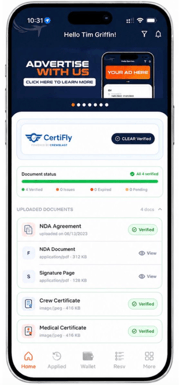
Every operator has additional onboarding requirements. W-9s. ACH information. Non-disclosure agreements. Company policies. Insurance documents. Internal acknowledgements.
Traditionally, those documents are requested only after a crewmember has been selected, creating unnecessary delays before the assignment can begin.
CrewBlast OS transforms onboarding into a configurable digital workflow.
Operators define their required documents once, and CrewBlast OS automatically manages the collection process. If information is missing or incomplete, the system notifies the crewmember before the operator ever becomes involved. By the time a staffing decision is made, much of the administrative work has already been completed.
Think of it as the aviation equivalent of arriving at airport security with TSA PreCheck. Much of the verification has already taken place before the process begins. That is the difference between reacting to staffing and preparing for it.
Security Is Part of Operational Readiness
Business aviation places tremendous emphasis on protecting sensitive information. Passenger itineraries, aircraft locations, maintenance records, and operational schedules are treated with discretion because they are part of delivering a premium aviation experience.
Staffing deserves that same standard.
Posting staffing requests on public forums can unintentionally reveal aircraft types, fleet growth, operating locations, or staffing shortages. CrewBlast OS replaces those public workflows with a private operator environment where staffing requests are distributed through a controlled network rather than open social platforms.
For principals who expect discretion in every other aspect of their operation, staffing should be no different.
CrewBlast Connect™: Staffing Based on Where Crew Actually Are
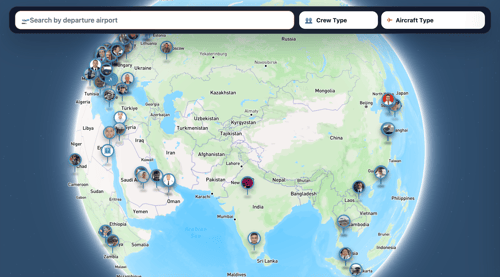 Traditional staffing systems assume that a pilot's home base is the most important piece of information.
In business aviation, it rarely is.
A Gulfstream captain based in Chicago may be spending the week in South Florida. A flight attendant who lives in Arizona may have just completed a trip in Teterboro. Another crewmember may be repositioning home tomorrow and happen to be exactly where your aircraft needs them today.
Most staffing platforms never see those opportunities because they search for where people live.
CrewBlast Connect™ was built to identify where qualified crewmembers actually are.
Using geolocation technology within the CrewBlast app, CrewBlast Connect gives operators the ability to identify qualified pilots and flight attendants who are physically near the assignment, regardless of where they call home. This dramatically expands the pool of available crew while reducing repositioning costs, travel time, and scheduling delays.
For operators, that means a staffing decision is no longer limited by a ZIP code on a profile. It becomes an operational decision based on real-world availability.
Imagine needing a Gulfstream captain in Aspen. Instead of searching only for pilots who are based in Colorado, CrewBlast Connect may identify a qualified captain who is already in Aspen after completing another trip, a pilot spending the weekend nearby, or a crewmember whose schedule places them there at exactly the right time.
Those opportunities have traditionally been invisible.
CrewBlast Connect makes them visible.
This is another example of the difference between a marketplace and operational infrastructure. A marketplace helps you search profiles. CrewBlast Connect helps you discover qualified crew based on where they actually are, allowing flight departments to make faster, more informed staffing decisions while significantly reducing unnecessary repositioning.
Operational Infrastructure for the Modern Flight Department
 The future of aviation staffing will not be defined by who builds the biggest marketplace.
It will be defined by who eliminates the need for one.
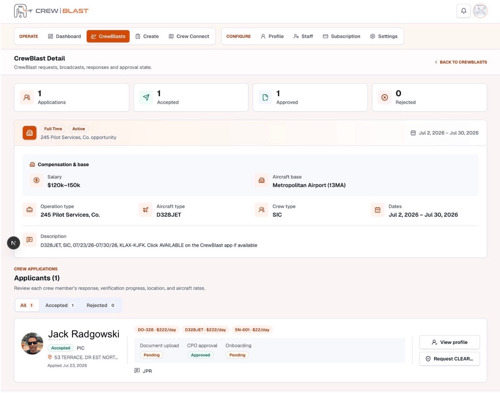
CrewBlast OS combines global staffing, preferred contractor management, AI Qualification Intelligence through CertiFly™, automated onboarding workflows, and both contract and full-time recruiting into a single operational platform built specifically for business aviation.
That is what infrastructure does. It removes friction before it becomes disruption.
The best flight departments don't wait until something goes wrong before investing in dispatch software, maintenance systems, or safety programs. They build those capabilities before they are needed because operational readiness has always been the hallmark of professional aviation.
Staffing should be no different.
The future of business aviation isn't about becoming better at searching for crew. It's about building the infrastructure that ensures you're already ready when the call comes.